Why Down Payments Matter in Car Financing
A down payment is the amount you pay upfront when buying a car, reducing the total amount you need to borrow. Because it lowers your principal, it affects nearly every part of your loan: the monthly payment, the total interest you pay over time, and sometimes even the interest rate you’re offered.
Lenders view a down payment as a sign of financial commitment. Putting money down reduces the lender’s risk because you have more equity in the car from day one, which can make it easier to get approved and may qualify you for better terms.
- A larger down payment means a smaller loan amount, which directly lowers your monthly payment.
- Paying more upfront reduces the total interest cost over the life of the loan.
- A down payment can help you avoid being “upside down” on the loan—owing more than the car is worth—especially in the early years when depreciation is fastest.
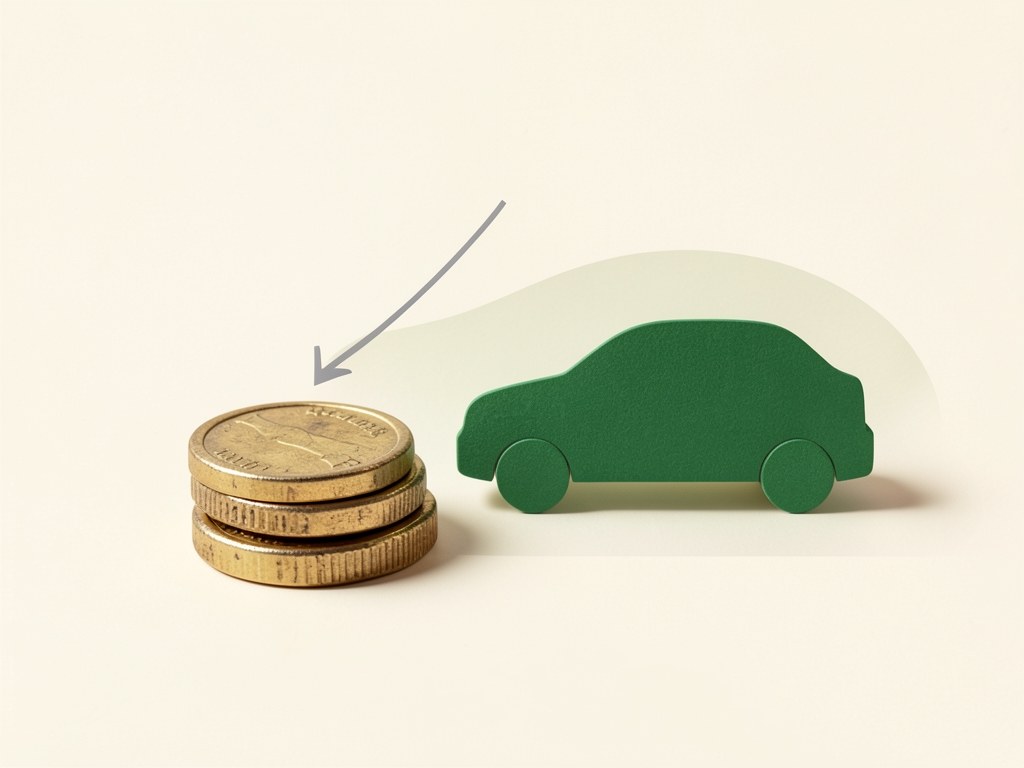
How Down Payment Affects Loan Amount and Monthly Payment
The most direct effect is on the loan principal. If you’re buying a $25,000 car and put $2,500 down, you borrow $22,500. A smaller loan means lower monthly payments and less interest charged each month.
Your monthly payment is calculated using the loan amount, the interest rate, and the loan term. The payment formula is: M = P × (r × (1 + r)^n) / ((1 + r)^n – 1), where M is the monthly payment, P is the principal (loan amount), r is the monthly interest rate (annual rate divided by 12), and n is the number of monthly payments (term in months). Using this formula shows that a higher down payment—which lowers P—reduces M proportionally, before considering any rate differences.
- Lower loan amount = lower monthly payment for the same rate and term.
- Lower loan amount = less total interest paid over the life of the loan.
- Even a modest down payment can make a noticeable difference in your monthly budget.
Comparing Down Payment Scenarios: 0%, 10%, 20%
In this example, moving from 0% to 20% down lowers the monthly payment by $96 and saves $800 in total interest. The savings are even larger if you compare longer terms or higher interest rates.
Note that the calculation uses the nominal annual interest rate divided by 12 for the monthly rate. The APR might be slightly higher if fees are included, but the table illustrates the relationship clearly.
| Down Payment | Loan Amount | Monthly Payment | Total Interest Paid |
|---|---|---|---|
| $0 (0%) | $25,000 | $483 | $3,998 |
| $2,500 (10%) | $22,500 | $435 | $3,598 |
| $5,000 (20%) | $20,000 | $387 | $3,198 |
Using Trade-In Value as a Down Payment
If you have a car to trade in, its value can be applied directly to the purchase price of your new car, acting as a down payment. This reduces the amount you need to finance just like cash does.
To get the most benefit, you need to know your car’s trade-in value before you negotiate. You can estimate it using tools like Kelley Blue Book or by checking recent sale prices for similar vehicles. The dealer will give you a trade-in offer, but you can negotiate that number, and you can also compare it to selling the car privately if you have time.
- Get a written trade-in offer before discussing the new car price so you know its value.
- The trade-in amount is credited toward the purchase, lowering your loan balance.
- If you still owe money on your current car loan, the payoff amount is subtracted from the trade-in value to determine your net equity.
Down Payment Assistance and Special Programs
Not every buyer has thousands of dollars available for a down payment. Some lenders offer low-down-payment or no-down-payment loans, particularly for borrowers with strong credit. In addition, certain credit unions, banks, and automaker financing programs may offer special promotions that reduce or eliminate the down payment requirement, especially for new models.
However, these programs often come with trade-offs, such as higher interest rates or shorter terms. Always read the fine print and compare the total cost of the loan, not just the monthly payment.
- Credit unions and community banks sometimes have more flexible down payment requirements.
- Automaker financing may offer 0% APR or other incentives, but they may require a higher down payment or stronger credit.
- Be cautious of “no down payment” ads—they may include higher rates or require excellent credit.
Pros and Cons of a Large Down Payment
A large down payment has clear benefits, but it also has potential downsides. Putting a significant amount of cash into a depreciating asset means tying up money that could be used elsewhere, such as an emergency fund or investments.
The right amount depends on your overall financial picture. A common rule of thumb is 20% down for a new car and 10% for a used car, but your personal budget and cash flow should guide the final decision.
- Pros: Lower monthly payments, less interest paid, lower risk of being upside down, and may improve loan approval chances.
- Cons: Uses cash that could be needed for other expenses, and you lose the opportunity cost of that money if it could have earned a higher return elsewhere.
How to Choose Your Down Payment
To decide on a down payment amount, start by calculating what you can comfortably afford upfront without draining your emergency savings. Then, use a loan calculator or the formula above to see how different down payments change your monthly payment and total interest.
Target a down payment that keeps your monthly payment within your budget and that gives you some equity in the car from the start. If you can’t put 20% down, don’t worry—any amount helps. Even 5% or 10% can make a meaningful difference.
- Set a budget for your monthly car payment, then work backward to find the loan amount you can afford.
- Aim for at least 10% if possible; 20% is ideal for new cars to avoid negative equity.
- Don’t deplete your emergency fund to make a large down payment—having cash reserves is important.
Frequently asked questions
What is the minimum down payment required for a car loan?
There is no universal minimum. Lenders may require as little as $0 down for well-qualified buyers, especially through special financing programs, but many lenders expect at least 10% to 20% to reduce risk. Your credit score, the car’s age, and the lender’s policies all influence the requirement. It’s best to ask several lenders about their specific down payment expectations.
Can I use a trade-in as a down payment?
Yes. The trade-in value you receive is applied to the purchase price, which reduces the amount you finance. For example, a $3,000 trade-in on a $20,000 car means you borrow $17,000, just as if you put $3,000 cash down. The trade-in must be paid off first if you still owe money on it; any remaining payoff is added to the new loan.
How does a larger down payment affect my interest rate?
A larger down payment can sometimes lead to a lower interest rate because it reduces the lender’s risk—you’re borrowing less and have more equity. However, the rate is primarily based on your credit score and current market rates. Some lenders tie better rates to higher down payments, but not always. It’s worth asking about rate reductions when you put more down.
What if I can't afford a large down payment?
You can still get a car loan with a small or even zero down payment, but you’ll have a higher monthly payment and pay more interest over time. Consider saving for a few months to build a down payment, focusing on a less expensive car, or exploring low-down-payment programs from credit unions or automaker financing. The key is to make sure the monthly payment fits your budget.
Does a down payment affect my loan approval chances?
Yes, typically. A down payment reduces the amount you need to borrow and gives you equity, which lowers the lender’s risk. This can improve your approval odds, especially if you have a limited credit history or a lower income. It also helps you avoid being upside down, which some lenders view favorably.